The complete guide
Candle warmer lamp vs burning the candle: what actually changes
If you have only ever burned candles, a warmer lamp sounds like a gadget solving a problem you do not have. Candles work. You light them, they smell nice, you blow them out. So it is worth being specific about what actually changes when the flame goes away — including the things that get slightly worse.
What gets better
The candle lasts. This is the big one. A burning candle consumes itself: the wax is fuel. A warmed candle loses only the fragrance oil evaporating off the surface, so the level in the jar drops slowly enough that people genuinely forget which month they started it.
No tunnelling. The classic candle failure is a deep hole down the middle with a thick ring of unused wax welded to the glass. That happens because a flame only melts what is near the wick. A warmer heats the whole surface at once, so every session melts corner to corner. It will even repair a candle that has already tunnelled.
No soot. Black smoke marks up the inside of the jar and, over time, the wall behind the candle. There is no combustion here, so there is nothing to deposit.
Control. With a flame, the scent is as strong as it is. With a dimmable warmer, you decide: low for a background note that lasts all evening, high when people are arriving and you want the hall to smell of the candle in ten minutes.
You can stop watching it. Nothing is on fire, and the timer switches it off. That is what lets people run a candle in a bedroom overnight or in a room where a cat lives.
What gets slightly worse
There is no flicker. A warmer glows, steadily. If what you love about candles is the moving flame, a warmer will not replace it — plenty of people run both, a warmer for the scent and a real candle when they want the movement.
It needs a socket. A candle goes anywhere. A warmer needs mains power and a cable, which rules out the middle of a dining table unless you are relaxed about a lead across it.
Bulbs are consumable. The warming bulb eventually fails, like any bulb. They are cheap and a spare comes in the box, but it is a small ongoing cost a match does not have.
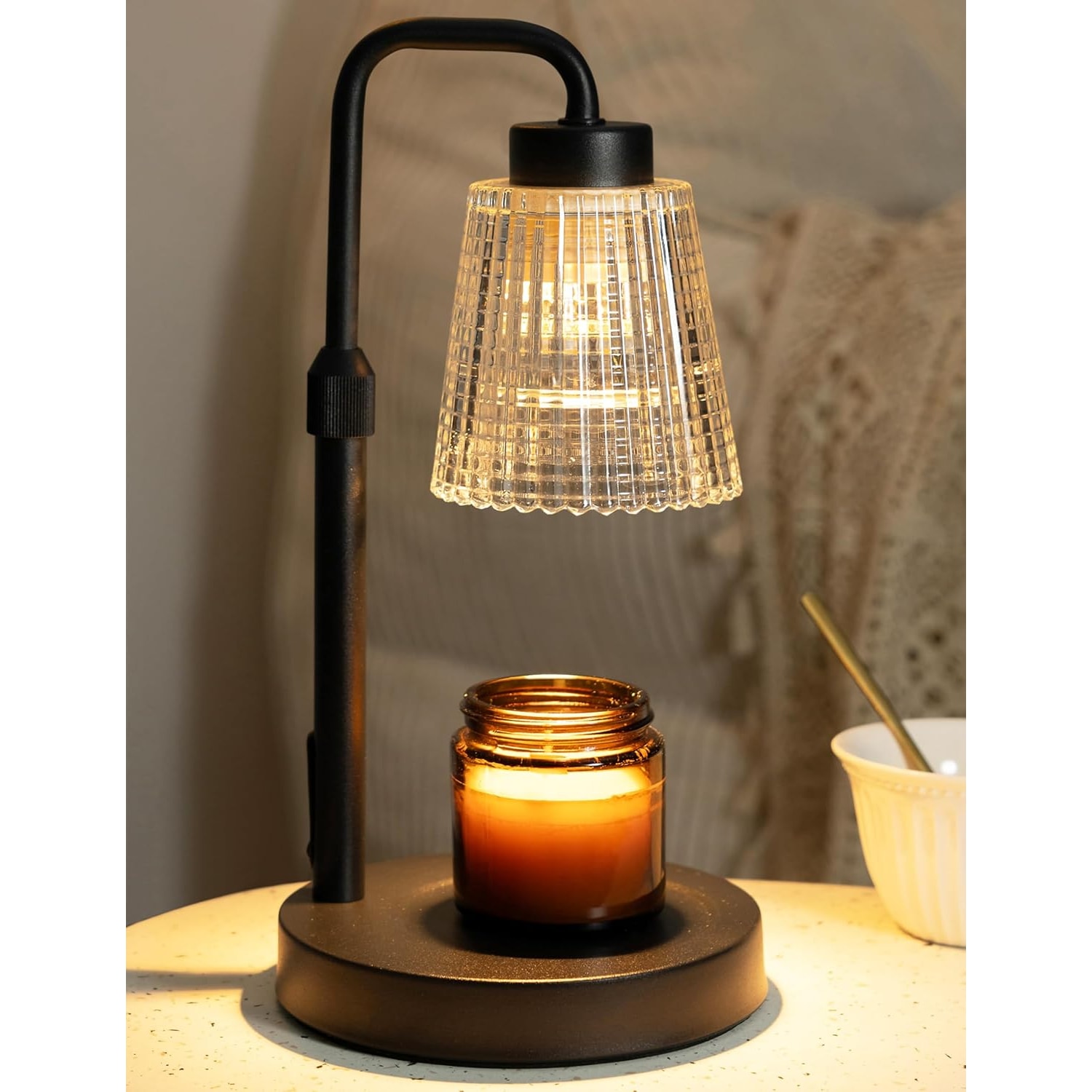
It is a lamp-sized object. A candle is a jar. This is 30 cm tall and lives on a surface permanently. That is a feature if you like how it looks — which is why choosing a finish that suits your room matters more than it first appears.
Which candles suit warming
Soy and coconut wax candles melt at lower temperatures and give up their scent readily, so they are the most forgiving. Paraffin works but likes a little more heat. Wide candles beat tall ones, because everything happens at the surface — a squat three-wick jar has far more surface area than a slim apothecary jar of the same volume, and will scent a room noticeably faster.
Glass jars are ideal. Metal tins work but heat quickly, so start the shade further away. Skip anything with dried flowers or wooden ornaments set into the wax, and anything in a plastic container.
Getting the most out of the dimmer
Because the bulb is the heater, the knob is really a scent-strength dial. The routine most people land on: start high for fifteen or twenty minutes to build a full, even pool of liquid wax across the surface, then turn it down to about half to hold the scent for the rest of the evening. Running flat out all night does not make a room smell better; it just spends the fragrance faster.
If the wax smells sharp or slightly burnt, it is running too hot — raise the shade or turn the knob down. If the edges never melt, do the opposite.
The short version
You trade the flicker and the go-anywhere convenience of a real flame for a candle that lasts, melts evenly, never sooties the glass, and can be left running safely on a timer. If the candle is mostly there for the scent, the warmer wins easily. If it is mostly there for the flame, keep both.