The complete guide
Why candles tunnel — and how a warmer lamp stops it
Tunnelling is the most common way a good candle gets wasted: a deep crater down the middle, a thick wall of unused wax welded to the glass, and a wick that eventually drowns in its own hole. Here is why it happens and why a warmer lamp does not do it.
Wax has a memory
The first time you light a candle, the pool of liquid wax spreads outward from the wick until you blow it out. Wherever that pool stopped, the wax sets — and on every subsequent burn, the candle tends to melt out to roughly that same edge and no further.
Light a new candle for twenty minutes and you set a narrow memory ring. From then on, the flame digs downward instead of outward, and the crater deepens each time.
Why it is hard to avoid with a flame
To avoid the memory ring you have to burn a candle long enough on its first use for the pool to reach the glass — often two to four hours for a wide jar. Most people do not have a spare three hours the first time they light something, and after the first session the pattern is set.
A flame also only heats what is directly above it. In a three-wick candle the wicks are usually set well inside the rim, so the outer centimetre never gets much heat even in a long burn.
What a warmer does instead
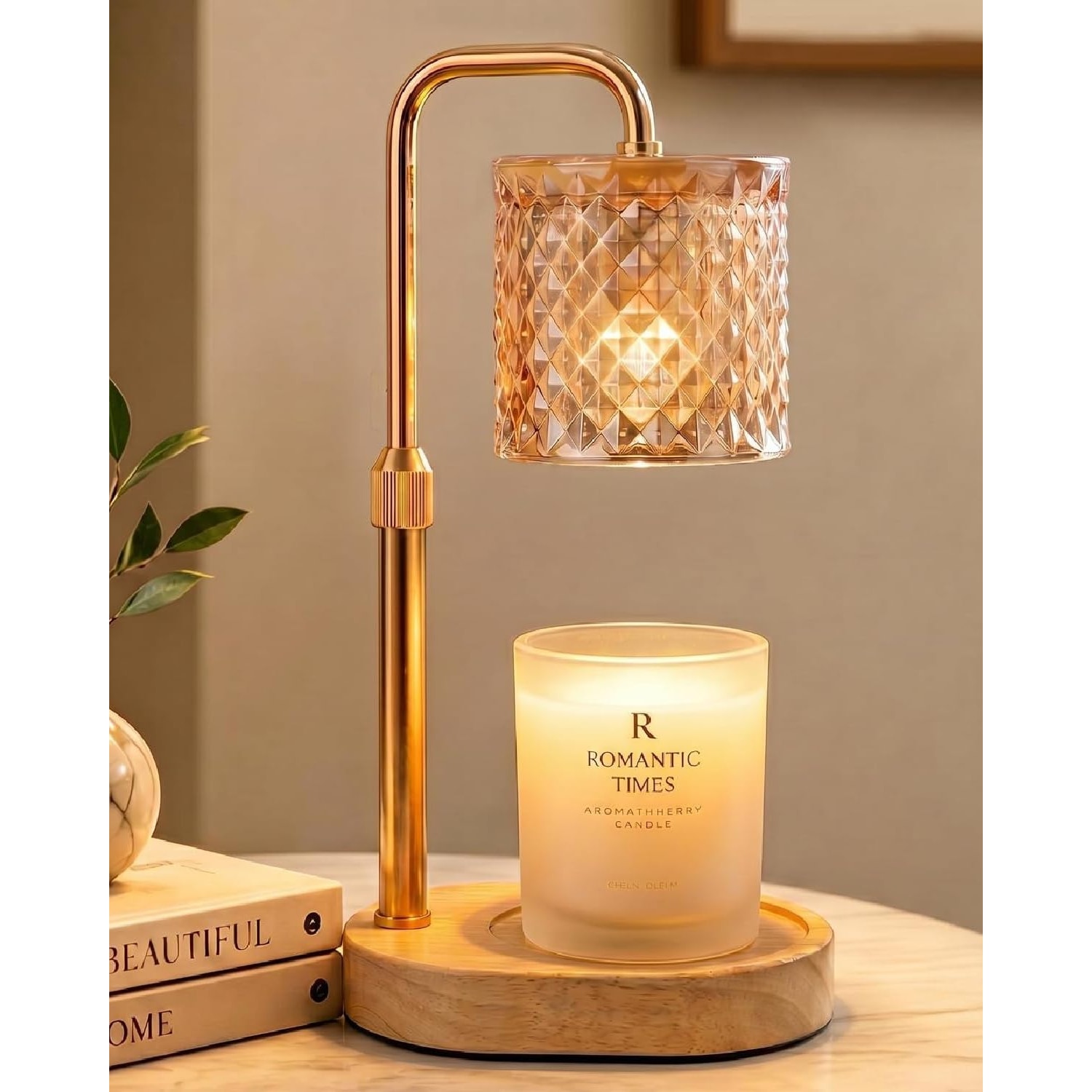
The bulb sits above the entire candle, not above one point in it. Heat arrives evenly across the whole surface, including the wax touching the glass, so the pool forms edge to edge from the very first session. There is no memory ring to set, because there is no narrow pool to remember.
That is also why a warmer can repair a candle a flame has already ruined. Put a tunnelled jar underneath, run it warm for two or three sessions, and the raised wall of wax around the outside softens and levels down into the crater. It is not instant, and a very deep tunnel may take several evenings, but the wax that was effectively lost comes back into use.
The practical rules
Set the shade 2 to 3 cm above the rim and check after twenty minutes. You want liquid wax right out to the glass.
Do not move the jar while it is liquid. Let it set flat — that flat surface is what you want to start from next time.
Give a deep tunnel time. Two or three longer sessions at a higher setting will do what a flame could not do in a month.
Trim, but do not fish out, the wick. You may want to light the candle normally one day, and the wick has no effect on warming.
When a candle is genuinely finished
Even on a warmer, a candle eventually runs out of fragrance while plenty of wax remains. That is the point to stop — it will still melt, but it will smell of nothing much. The last centimetre in the jar melts clean, which makes the glass easy to wash out and reuse as a small vase or a pen pot.
The short version
Tunnelling happens because a flame heats one spot and wax remembers where the pool stopped. A warmer heats the whole surface, so the pool reaches the glass every time and there is no memory to set. It will also rescue jars a flame has already tunnelled, given two or three patient sessions.